
There is a memo floating around Hollywood legend that single-handedly changed how studio executives thought about story. Christopher Vogler wrote it in 1985 as a seven-page distillation of Joseph Campbell’s The Hero with a Thousand Faces, and it reportedly circulated through Disney like a sacred text. The Writer’s Journey is that memo grown into a book. It is essential reading for screenwriters and fiction writers, a useful provocation for nonfiction writers, and an occasionally exhausting exercise in over-systematizing something that resists systems. Worth reading. Worth arguing with.
What the Book Is Actually Arguing
Vogler’s central claim is disarmingly simple: all stories, across all cultures and all of recorded history, follow the same deep structure. Campbell called it the monomyth. Vogler calls it the Hero’s Journey, and he maps it onto twelve stages: the Ordinary World, the Call to Adventure, Threshold Guardians and Ordeals, and finally the Road Back with the Reward. Alongside the stages, he identifies eight character archetypes: Hero, Mentor, Herald, Shapeshifter, Shadow, Trickster, Ally, and Threshold Guardian. Each functions less as a character type and more as a psychological role that any character can occupy at different moments in a story.
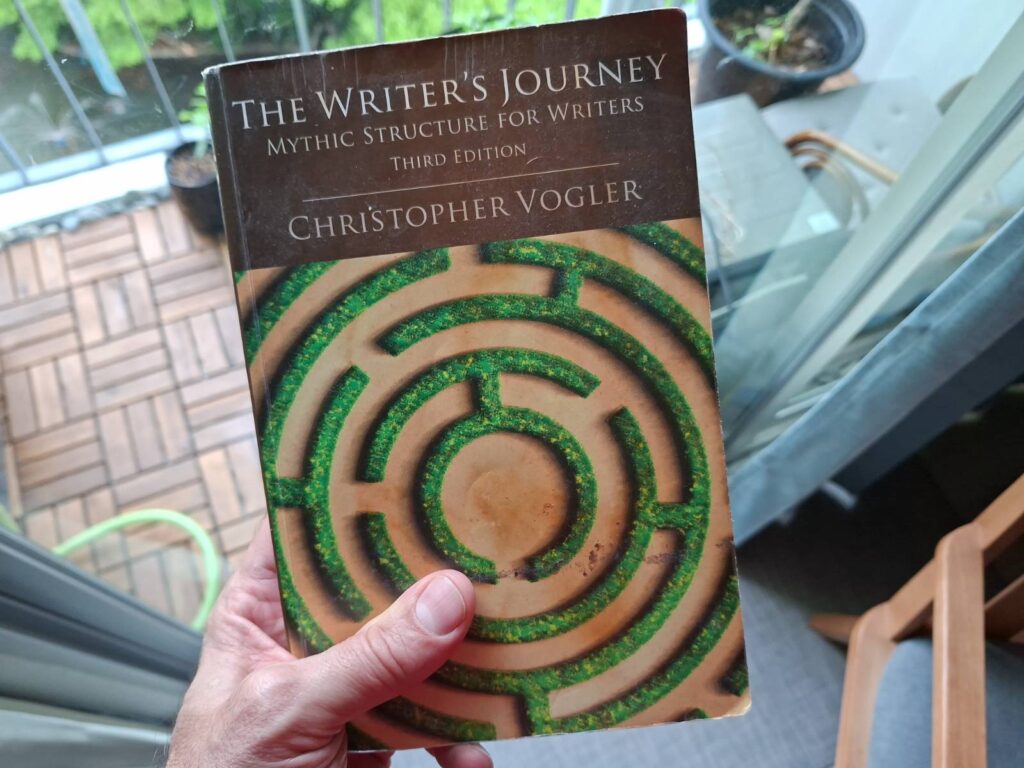
Vogler spent decades as a story analyst and consultant for studios including Disney and Warner Bros., and that professional DNA runs through every page. This is a practitioner’s book, not a scholar’s. He isn’t interested in defending Campbell against academic criticism. He’s interested in whether the framework helps writers make better stories. The honest answer, which the book supports, is that it often does — and occasionally, it becomes a cage.
Where the Book Succeeds
The book is at its best when Vogler moves away from the schematic and toward the psychological. His chapter on the Shadow archetype is genuinely illuminating. The Shadow is the villain, yes, but more precisely the embodiment of the hero’s repressed fears and desires. He makes the convincing case that the most powerful antagonists aren’t opposed to the hero externally, but internally. They represent what the hero could become, or secretly wants to be.

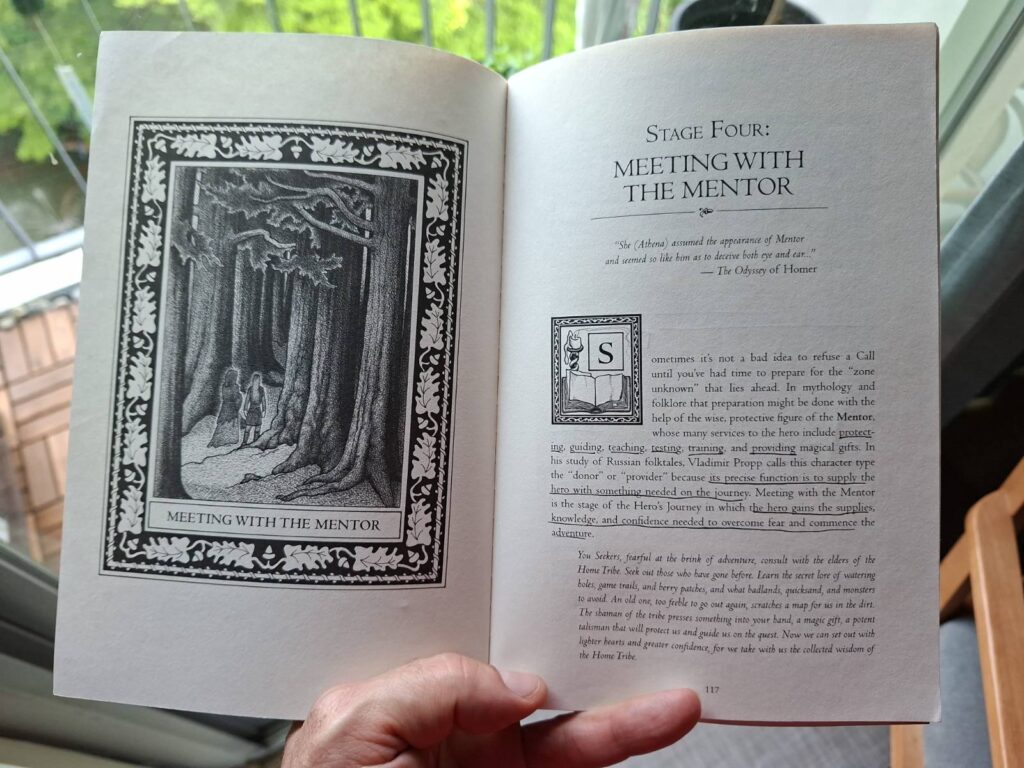
His treatment of the Mentor archetype is similarly rich. The Mentor’s defining dramatic function, Vogler argues, is not to solve the hero’s problems but to give them just enough to face the next threshold, then to die, depart, or fail, because a hero who can always run back to the Mentor never truly grows. That insight has genuine reach far beyond screenwriting.
The prose is approachable, the film examples are well-chosen, and Vogler’s willingness to acknowledge that not every story hits every stage in order earns him credibility.
The Practical Takeaways
1. Map your subject’s transformation, not just their actions. The Hero’s Journey is fundamentally about internal change catalyzed by external events. Nonfiction writers, especially biographers, narrative journalists, and memoirists, can use the twelve stages as a diagnostic. If your subject never crosses a true threshold, never faces an ordeal that strips away their old identity, you don’t have a story yet. You have a profile.
Before: In 1987, Sara left her corporate law firm and started a small environmental nonprofit. She hired a team, secured funding, and within five years had lobbied successfully for three pieces of state legislation.
After: Sara had spent twelve years becoming exactly the kind of lawyer she once swore she’d never be. Leaving the firm didn’t feel like a triumph — it felt like an amputation. She didn’t know yet that you have to lose the old self before the new work can mean anything.
2. Every piece of nonfiction needs a Shadow. Vogler’s Shadow isn’t always a person. For nonfiction, the Shadow is whatever force, whether an ideology, a system, or an internal contradiction, most threatens the central argument or subject. Name it explicitly. Give it full dramatic weight. Nonfiction that refuses to take its own Shadow seriously feels thin.
Before: The opioid crisis devastated rural communities across Appalachia. Pharmaceutical companies aggressively marketed painkillers to doctors, and addiction rates climbed sharply through the 2000s.
After: The crisis had a face, and it belonged to the same industry that had promised relief. Every town that lost someone to opioids had also, at some point, celebrated the arrival of a new prescription option, the very thing that would hollow it out.
3. The Mentor’s gift should cost something. In any nonfiction narrative where a mentor figure appears, the most interesting dramatic question isn’t what they gave. It’s what they withheld, and why. Build that tension deliberately.
Before: Dr. Okonkwo took Marcus under her wing during his residency. She taught him everything she knew about emergency medicine and wrote him a glowing recommendation when he applied for a fellowship.
After: Dr. Okonkwo taught Marcus everything. Except how she’d survived the lawsuit. That silence, he would later understand, was its own kind of lesson: some knowledge you have to earn by almost losing something first.
4. Use the “Ordinary World” to establish what’s at stake before disrupting it. Nonfiction writers often rush to the inciting event. Vogler’s framework insists you earn the disruption by first grounding the reader in what was, the baseline reality the story will shatter. This is the difference between a scene landing and a scene merely occurring.
Before: In March 2008, the bank notified the Delgado family that their mortgage was underwater. They had thirty days to vacate the home they’d lived in for nineteen years.
After: On Sunday mornings, Rosa Delgado made tamales in the same kitchen where her mother had taught her, where her own daughter now watched from the same stool. The letter arrived on a Tuesday in March. Thirty days to vacate.
5. Archetypes are functions, not boxes. The most liberating idea in the book is that any character can occupy multiple archetypal roles across a narrative. In nonfiction, this means your subject can be Hero in one chapter, Shadow in the next, and Mentor in the last. Track those shifts. They create depth.
Before: Robert Moses was a powerful and controversial urban planner who shaped New York City for decades. He was admired by some and criticized by others for his sweeping vision and authoritarian methods.
After: For a generation of young planners, Moses was the answer to every problem, until he became the problem itself. The man who had taught them to think big was now the reason nothing could get built at all.
The Honest Criticisms
The book’s greatest weakness is also its most seductive feature: the completeness of the system. Vogler presents the Hero’s Journey with such confident totality that it can trick writers into mistaking the map for the territory. Stories that don’t fit the mold get awkwardly forced into it. The twelve stages become a checklist, and checklists are the enemy of genuine discovery.
There’s also a cultural parochialism that Vogler nods at but never fully reckons with. Campbell’s monomyth was drawn heavily from Western and Greco-Roman mythology, and while Vogler gestures toward its universality, the framework quietly privileges certain story shapes over others. Writers working in traditions outside that lineage should hold the template loosely.
Who Should Read It
The Writer’s Journey is essential for screenwriters and narrative nonfiction writers: journalists, memoirists, and biographers who feel their stories are structurally sound but emotionally inert. If your drafts are factually complete but somehow lifeless, Vogler will show you where the psychological current has gone missing. Essay writers and critics can safely skip it. Those writing argument-driven nonfiction will find the framework too story-dependent to be of much direct use. The Shadow alone, though, is worth the price of admission.
